Has the First Space War Already Started? What the 2026 Orbital Breakups Actually Show
SCIENCE & TECHNOLOGY · OCTOBER 7, 2026
On 7 October 2026, Stephen Fleming (@StephenFleming) posted: "It's possible that the First Space War has already started and they're just not telling us." He was quoting the orbital-tracking company LeoLabs, which had just written that it "has detected another debris-generating event in orbit. This is the latest in a series of events we've seen over the last 6 months." The post drew a couple of hundred thousand views. It is a good question to ask and a poor one to answer from a tweet, so this entry sets out what was actually detected and what a tracking company can and cannot know.
What LeoLabs has detected in 2026
LeoLabs runs a commercial network of ground radars that tracks objects in low Earth orbit. Three of its 2026 fragmentation reports are worth lining up, because they have very different parents:
- Starlink 34343, 29 March. LeoLabs saw "tens" of new objects around the satellite at roughly 560 km. SpaceX confirmed an "anomaly on-orbit" and has not published a root cause. Analysts pointed to an internal energetic source, such as a battery or propulsion tank, rather than a collision. It was reportedly the second Starlink breakup in about three months, after Starlink 35956 in December 2025.
- Chinese Long March 6C rocket body, 27 August. LeoLabs logged a fragmentation at 02:30 UTC of the upper stage (NORAD ID 100472), in an orbit with a 396 km perigee and 482 km apogee. Tens to hundreds of fragments were reported.
- Soviet-era Meteor 2-7, 5 October. The latest event. LeoLabs' network found multiple objects near the long-dead weather satellite, which has been in orbit for more than 45 years. The cause is listed as unknown.
So the pattern is real in the narrow sense: tracked breakups keep happening, and they are being publicized quickly. What the three have in common is that none of them has an attributed cause, and that none of them looks like the same kind of object.
"Fragment creation event" is a deliberately neutral phrase. It means the radar saw one object become several. It says nothing about why. An explosion, a collision, a thermal failure and a deliberate intercept all produce the same first observation.
The ordinary explanations come first
Most orbital breakups are not hostile. Upper stages and old satellites hold leftover propellant, pressurized tanks and batteries. Years in the thermal cycling of orbit, those can rupture with no outside cause. This is a long-recognized source of debris: spent rocket bodies and defunct spacecraft have been breaking up since the 1960s. A 45-year-old Soviet weather satellite is exactly the kind of object this happens to. A Starlink losing a battery is a less comfortable story, but it is also a mechanical one.
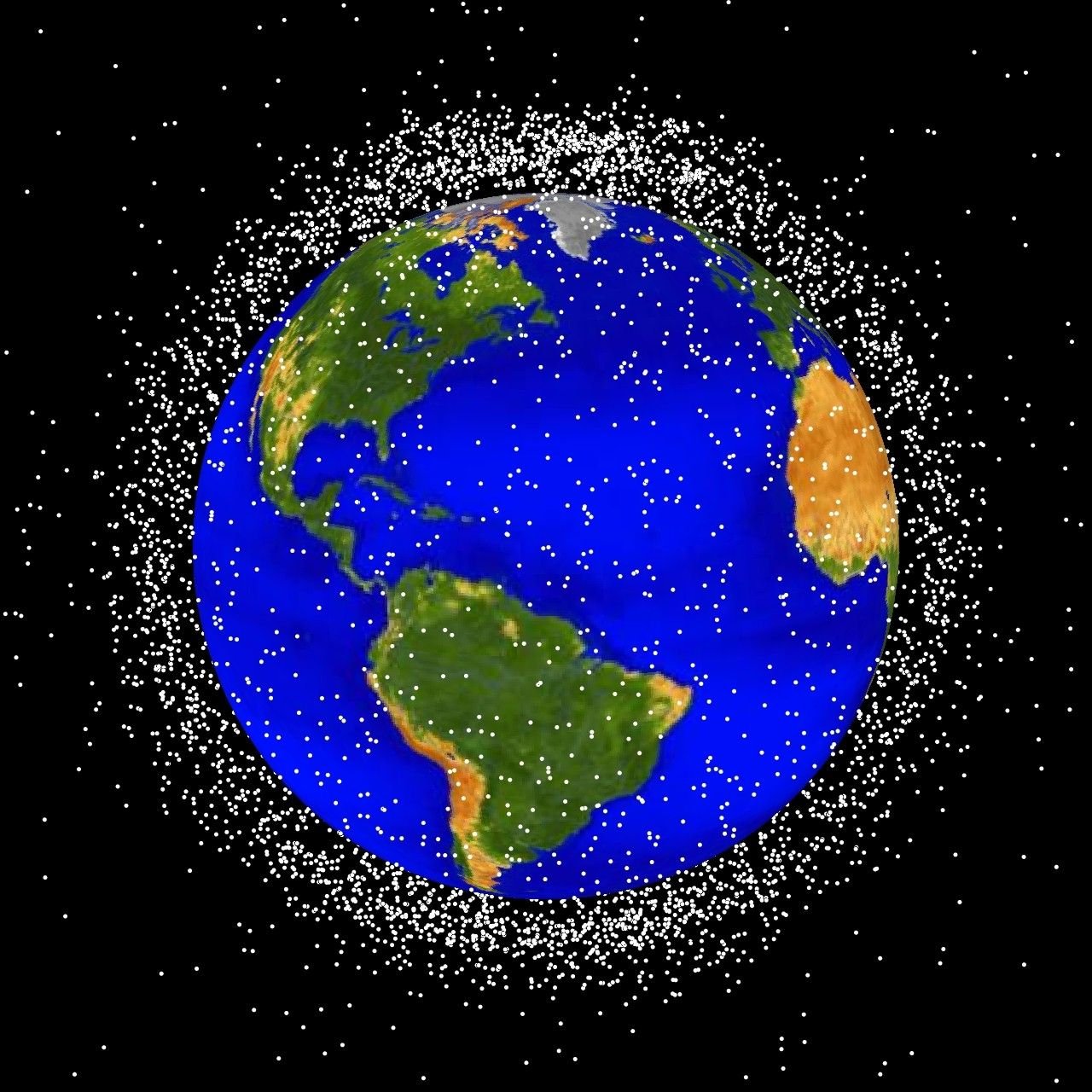
A second factor is that there is much more to see and much more to hit. ESA's 2026 environment assessment, as summarized by FOD News, puts low-orbit collision risk up about 20 percent between 2024 and 2026. Over 40,000 objects are catalogued, ESA's model estimates about 54,000 larger than 10 cm, and around 1.2 million between 1 and 10 cm that are too small to track reliably but large enough to kill a satellite. Starlink is said to have performed roughly 300,000 collision-avoidance maneuvers in 2025. I have not been able to check those figures against ESA's own report, so treat them as the secondary source's numbers.
Better detection also matters. A commercial radar network that publishes every event within hours will make "a series of events" look new even if the underlying rate were steady. That alone doesn't explain 2026, but it belongs in the account.
What an attack would look like in tracking data
An actual weapon test in orbit is not subtle, and there is precedent for what one looks like. Russia's November 2021 destruction of its own Cosmos 1408 satellite produced well over a thousand trackable fragments, and Chinese (2007) and Indian (2019) tests before it are the other standard examples. The things that separate a test from an accident are:
- The parent object. A functioning military satellite breaking up is a different signal from a derelict stage.
- The fragment spread. A hypervelocity impact throws debris in a characteristic distribution and often a large cloud. A tank rupture is usually smaller.
- A second object nearby. A kinetic intercept needs an interceptor. Tracking will often show a launch or a close approach beforehand.
- The government reaction. Tests get condemned, and the US Space Command and others publish their own tracking.
The coverage I read of the three 2026 events mentions none of those signs, though I was reading reports of the breakups, not searching for evidence of an attack. That is an absence of evidence, not proof, and the honest limit is that a commercial tracking company sees where objects went, not who did what. LeoLabs itself has not suggested hostile action; the framing comes from the people sharing the post.
Why the breakups matter even if nobody is shooting
Every breakup in a crowded orbit adds fragments that raise the odds of the next collision. The worst case, usually called the Kessler syndrome, is a cascade in which collisions create the debris that causes more collisions. Nobody is claiming we are there. But the 550 km shell that Starlink prefers is also where debris density is reportedly approaching the density of active satellites, according to the same ESA summary, and a satellite that dies unpredictably in that shell is a problem for everyone who flies through it. The World Economic Forum's 2026 report, Clear Orbit, Secure Future, puts the decade cost of debris in the tens of billions of dollars.
Where I could be wrong
I read LeoLabs' posts and secondary coverage, not the radar data, and I could not open the full text of the Meteor 2-7 report, so the object count and altitude for that event are left out rather than guessed. If a government or LeoLabs later attributes one of these events to a deliberate act, this entry is out of date and should be rewritten. And the claim "they're just not telling us" is, by construction, something this kind of evidence can never rule out. What it can say is that the visible record so far looks more like old hardware failing in a crowded sky than like a war.
Sources
- Stephen Fleming (@StephenFleming), quoting LeoLabs (@LeoLabs_Space). X, 7 October 2026. https://x.com/StephenFleming/status/2107866005292892455
- SpaceWatch.GLOBAL. LeoLabs Detects New Fragment Creation Event Involving Soviet-Era Meteor 2-7. October 2026. https://spacewatch.global/2026/10/leolabs-detects-new-fragment-creation-event-involving-soviet-era-meteor-2-7/
- LeoLabs (@LeoLabs_Space). Long March 6C rocket-body fragmentation, 27 August 2026. https://x.com/LeoLabs_Space/status/2093361139518144653
- LeoLabs (@LeoLabs_Space). Starlink 34343 fragment creation event, 29 March 2026. https://x.com/LeoLabs_Space/status/2038680177408880719
- KeepTrack. Starlink-34343 deep dive. https://keeptrack.space/deep-dive/starlink-34343
- FOD News. ESA: LEO Debris Collision Risk Up 20% in 2026 (summary of ESA's report). https://fodnews.com/esa-space-environment-report-2026-leo-debris-collision-risk/
- World Economic Forum. Clear Orbit, Secure Future: A Call to Action on Space Debris. 2026. https://reports.weforum.org/docs/WEF_Clear_Orbit_Secure_Future_2026.pdf