Two Sea Spiders Nobody Had Named in Nearly a Hundred Years
SCIENCE & TECHNOLOGY · SEPTEMBER 26, 2026
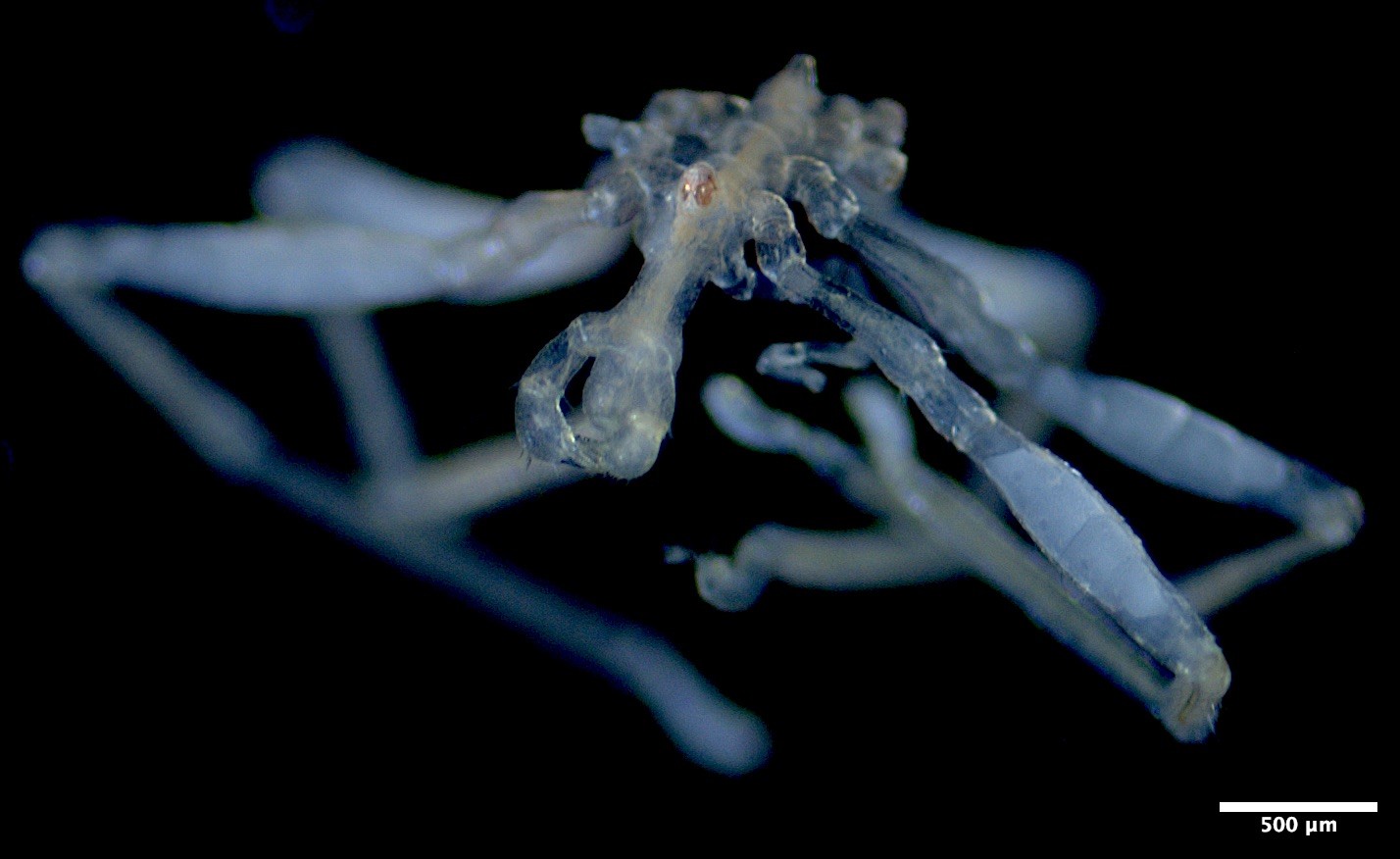
Two sea spider species new to science have turned up in British Columbia's Salish Sea, described this month by Cormac Toler-Scott, a University of British Columbia master's student in zoology, in a paper in the journal Organisms Diversity & Evolution. They're the first sea spiders anyone has formally named from these waters in almost a hundred years: a red-eyed, three-lipped species called Callipallene pilosuspedes, and a smaller, parasite-covered one called Tanystylum kiixin. Both came up on scientific dives to depths of 18 metres, taken between September 2023 and August 2024 at sites around Quadra Island, Vancouver, Bamfield and Victoria — ordinary, well-trafficked coastal waters, not some remote trench nobody visits.
What a Sea Spider Actually Is
A sea spider isn't a spider. Both belong to the arthropods, but sea spiders make up their own class, Pycnogonida, which sits closer to spiders, scorpions and horseshoe crabs (the chelicerates) than to true insects — a lineage so old and strange that biologists still argue about exactly where its family tree splits off. What makes them recognizable is the body plan: legs — eight, sometimes more — radiating from a body so reduced that some species carry parts of their gut and gonads out into the legs themselves, because there's nowhere else to put them. Toler-Scott sums up the rest of the strangeness: "They've retained some weird traits. A lot of the shallow-water species are quite small, and so they'll live as parasites on larger organisms, and they use this weird apparatus called a proboscis to suck the juices out of their host." That proboscis — a rigid, often clawed feeding tube — is doing a lot of work for an animal with no obvious mouth in the conventional sense.
Why Nobody Had Named Them Sooner
The honest answer isn't that these species are rare or newly arrived — it's that almost nobody has been looking. Toler-Scott went in wanting to study how sea spiders respond to climate change and human disturbance, on the reasonable assumption that a well-known inland sea bordering a major research university would already have that baseline data. It didn't. "I was interested in how sea spiders are impacted by climate change and human disturbance, because marine invertebrates in the Salish Sea are particularly at-risk, and I couldn't find anything," he told UBC News — "because people don't know much about what species exist here and what their lifestyle is." So the thesis became the baseline: a comparative morphology and DNA barcoding survey of seven coastal sea spider species from the region, two of which turned out not to have names at all. As Toler-Scott put it, the identification problem comes first: "In order to understand how marine invertebrates are being impacted by things like climate change and how we can better protect these key elements of the ecosystem, we have to be able to identify them."
The names themselves are doing some work too. Callipallene pilosuspedes is a small Latin joke — pilosus plus pedes, "hairy feet," for the long curved spines on its lower legs. Tanystylum kiixin is named for Kiix̣in (pronounced "kee-hin"), the ancient capital of the Huu-ay-aht First Nations near Bamfield, a national historic site since 1999 and the only place on British Columbia's southern coast where standing traditional longhouse remains still survive — the specimens were first collected on dives near the village site, and the name is drawn from the sound of waves against its shore.
A Three-Lipped Mouth That Also Grooms
Callipallene pilosuspedes — known so far from a single specimen — has red eyes, a short clawed proboscis for grasping prey before biting in, and a triangular, three-lipped mouth ringed with sensory tendrils. What caught Toler-Scott's attention wasn't the mouth, though, but the ovigers: the leg-like appendages most male pycnogonids use to carry fertilized eggs. On this species they're unusually dexterous, and Toler-Scott watched the animal wrap them around its own legs and run comb-like spines along them to groom itself. Tanystylum kiixin drew the short straw on that front — its ovigers are smaller and far less dexterous, leaving it unable to clean itself, and its body was found carrying its own protist parasites. Toler-Scott's description of that specimen is the best line in the whole release: "an ecosystem within an ecosystem within an ecosystem."
Where I Could Be Wrong
A species built from a single specimen — C. pilosuspedes — is a real taxonomic risk: a lone individual can carry developmental oddities that later turn out not to be diagnostic once more specimens turn up, and pycnogonid taxonomy in particular has a history of splits and lumps as DNA barcoding catches morphological look-alikes that were previously called the same species (or separates ones that weren't). I haven't read the full paper, which sits behind a journal paywall I didn't access — everything here is drawn from UBC's press materials and the secondary science coverage that quotes Toler-Scott directly, not from the methods or the phylogenetic tree itself. And "the first new species named here in almost a century" is UBC's framing, not a claim I independently verified against the full history of Salish Sea pycnogonid taxonomy — it's very plausible given how thin the record clearly was, but I'm taking their word for the specific interval.
Sources
- Toler-Scott, C. et al. Sea spiders of the Salish Sea: Comparative morphology and molecular phylogenetic analysis of seven coastal species (Arthropoda, Pycnogonida). Organisms Diversity & Evolution, September 2026. DOI: 10.1007/s13127-026-00707-3
- UBC News. Hairy-legged, red-eyed sea spiders discovered in the Salish Sea. September 2026. news.ubc.ca
- UBC Science. Hairy-legged red-eyed sea spiders discovered in the Salish Sea. September 2026. science.ubc.ca
- Phys.org. Hairy feet, red eyes: Salish Sea reveals two sea spider species new to science. September 2026. phys.org
- Huu-ay-aht First Nations. Kiix̣in Village and Fortress National Historic Site. kiixin.ca