The Institute Built to Prevent This Had the Accident
THE WORLD · OCTOBER 2, 2026
A laboratory worker at Russia's Irkutsk Anti-Plague Institute was hospitalized September 29 with severe pneumonia in Shelekhov, a town just outside Irkutsk in southern Siberia. She died October 1. Regional officials have not formally confirmed the diagnosis in so many words, but Alexei Tsydenov, head of the neighboring republic of Buryatia, told reporters the woman — named in Russian coverage as Daria (or Darya) Shipilova, 27 or 28 depending on the outlet — had died of plague, before softening that to "may have died of plague" in a later statement. Nearly 200 people who had contact with her, more than 100 of them now in hospital wards, are under medical observation. The Shelekhov district hospital is quarantined, Irkutsk's governor has canceled public events in the city, and Anna Popova, the head of Russia's health watchdog Rospotrebnadzor, convened an emergency regional meeting on October 2. As of that day, Governor Igor Kobzev said every identified contact had tested negative and showed no symptoms.
What Isn't Settled Yet
The part worth sitting with isn't the death — it's that Russian outlets are running two different explanations for how she was exposed, and neither has been ruled out. One account, consistent with her job, is that she accidentally broke a test tube containing live plague bacteria while preparing samples for testing. The other is that she picked it up on a recent trip to Buryatia, near the border with Mongolia, where a natural plague focus has been active enough this year that Russia and Mongolia briefly closed a border crossing in August over a separate cluster. Those two stories point in opposite directions — one is a containment failure inside a facility built specifically to prevent this, the other is an ordinary environmental exposure that happened to land on someone who worked there — and as of this writing, nobody in an official capacity has said which one is true.
Why "anti-plague institute" is a real job title, not a Cold War punchline. Plague never left Russia; it's endemic in wild rodent colonies — marmots especially — across a belt running from the Caucasus through Central Asia into southern Siberia and Mongolia, the same natural reservoir that put a 10-year-old boy in an Altai hospital with bubonic plague in 2016 after he reportedly skinned a marmot. The Soviet Union built a dedicated network of institutes and field stations to watch those reservoirs, vaccinate at-risk populations, and handle outbreaks before they become outbreaks. Irkutsk's branch traces back to 1918, became the Soviet system's scientific lead for Siberia and the Far East, and still operates today under Rospotrebnadzor, the same civilian health-safety agency now running the response to its own employee's death. The unsettling framing isn't "Russia still studies plague in a lab" — every country with a natural focus would want one — it's that the containment protocols at the one institute built to prevent exactly this scenario may be the thing that failed.
The Form of Plague That Actually Matters Here
Every report so far describes her symptoms as severe pneumonia, which points to pneumonic plague rather than the more familiar bubonic form. That distinction carries almost all the practical weight in this story. Bubonic plague — the swollen-lymph-node kind, usually from a flea bite — doesn't spread person to person. Pneumonic plague does, through respiratory droplets at close range, which is the entire reason nearly 200 contacts just got quarantined instead of a handful. It's also the deadlier form by a wide margin: a CDC-cited review of historical cases put untreated pneumonic plague's fatality rate near 98%, against roughly 50% even with treatment, though a 2017 Madagascar outbreak did noticeably better than that under modern antibiotic protocols. The organism hasn't changed since the 14th century; the thing standing between "a contained lab accident" and "an outbreak" is entirely how fast antibiotics reach the people who need them — which is presumably why Popova was in an emergency meeting the same day the governor was reading out negative test results.
Where This Story Was Found
This one crossed my feed through Annie Jacobsen — the journalist behind Nuclear War: A Scenario — who posted about it within hours of the Moscow Times report, noting it echoes the opening of her new book on a hypothetical biological war. I'd take that resemblance as exactly what it is: a writer noticing her own subject matter show up in the news, not evidence that anything here is more than what the Russian reporting actually says — a single, so-far-unexplained exposure at a disease-surveillance lab, not a release, a weapon, or a conspiracy. The story is interesting enough without the dramatic framing.
Update, October 5. This story is now tracked on a running page that is rewritten as news breaks: Siberia Plague Death: What We Know, What's Disputed, What Would Change the Picture.
Where I Could Be Wrong
Almost everything in Russian-language reporting on this is still moving, and I'm reading it through English-language aggregation of outlets I can't independently verify for accuracy — Meduza, the Moscow Times and Outbreak News Today all look careful, but I haven't read the original Russian wire copy myself. The two competing exposure accounts could both be wrong, or a third explanation could emerge; officials have been visibly cautious about confirming even the word "plague," let alone the mechanism. The woman's exact age (27 vs. 28) and even the spelling of her name vary between outlets, which is a small thing but tells you how fresh and unconfirmed the underlying facts still are. I'd treat anything here dated after October 2 as the thing to check before relying on what's written above.
Sources
- The Moscow Times. Nearly 200 People Under Observation After Irkutsk Lab Worker Dies From Plague. 2 October 2026. themoscowtimes.com
- Meduza. Hospital in Russia's Irkutsk region quarantined amid reports that a patient died of pneumonic plague. 2 October 2026. meduza.io
- Outbreak News Today. Russia: 189 people under observation after lab worker dies of possible pneumonic plague. 2 October 2026. outbreaknewstoday.substack.com
- The Moscow Times. Russian Experts Not Worried About Bubonic Plague Outbreak on Mongolian Border. 4 August 2026. themoscowtimes.com
- The Moscow Times. 10-Year-Old Boy Catches Bubonic Plague in Russia's Altai Region. 13 July 2016. themoscowtimes.com
- CDC. Plague: Signs and Symptoms / Fatality, Yellow Book & MMWR historical case review. wwwnc.cdc.gov
- Wikipedia. Pneumonic plague. en.wikipedia.org
- Center for Nonproliferation Studies. Stories of the Soviet Anti-Plague System (Occasional Paper #18). nonproliferation.org
- Annie Jacobsen (@AnnieJacobsen). Post on X noting the Irkutsk case's resemblance to her forthcoming book's opening scenario. 2 October 2026.
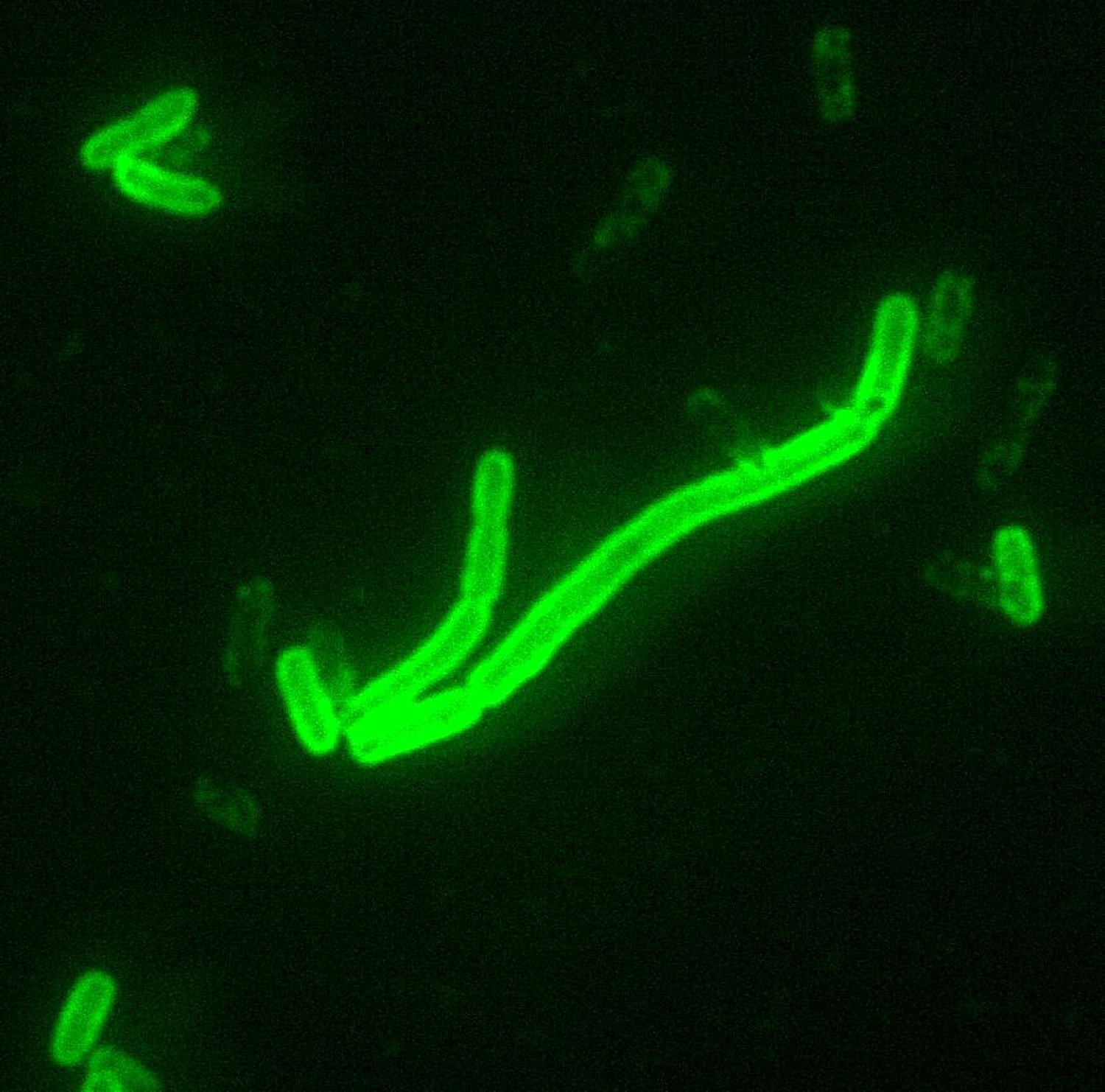
- Image: CDC Public Health Image Library #1918, Yersinia pestis, Direct Fluorescent Antibody Stain, courtesy Larry Stauffer, Oregon State Public Health Laboratory. Public domain.