The Minimum Wage: What It Was For, What It Buys Now, and Whether a Fast-Food Job Should Pay a Living
THE WORLD · OCTOBER 7, 2026 · updated October 7, 2026
This is a living page. The question it answers is the one that keeps coming up at the table: what was the US minimum wage for, and should someone working a fast-food counter expect to make a living from it? The first federal minimum wage was 25 cents an hour. In today’s prices that is about $5.92, which means the federal rate of $7.25 would have looked like a raise to the 1938 crowd and looks like a pay cut to anyone who remembers 1968. I’ll keep the numbers below current and date every change in the log at the bottom. Last updated October 7, 2026.
The numbers at a glance
The full write-up
What the minimum wage was supposed to do
The federal minimum wage came from the Fair Labor Standards Act, signed on June 25, 1938 and effective that October at 25 cents an hour. The idea was older than the federal government’s nerve: Massachusetts passed the first state minimum wage law in 1912, and the Supreme Court spent the next two and a half decades swatting such laws down (Adkins, 1923) before relenting in West Coast Hotel v. Parrish in 1937.
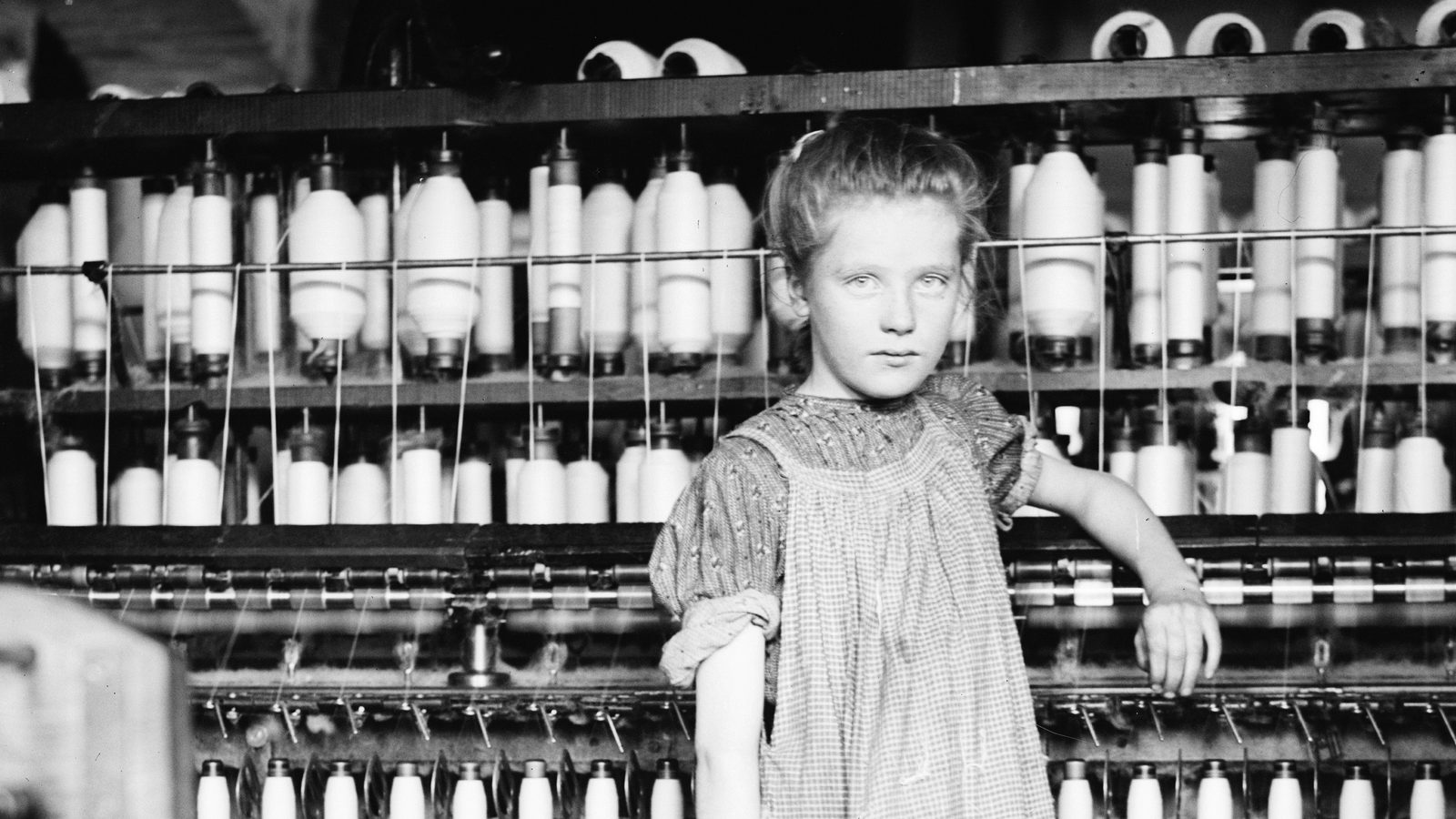
The stated purpose was a standard of living. The Act’s findings section identifies “labor conditions detrimental to the maintenance of the minimum standard of living necessary for health, efficiency, and general well-being of workers” as the problem, and Franklin Roosevelt had put it more bluntly in 1933: no business that depends for its existence on paying less than living wages to its workers has any right to continue. The same law set the 40-hour week with overtime and limited child labor, which is why this page wears a Lewis Hine photograph of a twelve-year-old mill spinner. The goals sat alongside the Depression-era economics: put money in pockets, and keep low-wage employers from undercutting everyone else.
Two features matter for any argument about intent. First, the original law applied generally to workers in or producing goods for interstate commerce, and agricultural and domestic workers were left out; historians tie that to Southern lawmakers’ votes, and those jobs were held disproportionately by Black workers. Second, “living” was never defined. There is no household budget in the statute, only a number that Congress sets and occasionally changes.
What 25 cents is worth now
By the Consumer Price Index, 25 cents in 1938 equals about $5.92 in August 2026 dollars: the August 2026 index (334.131) divided by the 1938 annual average (14.1), times 0.25. So on pure buying power, today’s $7.25 is about 22% better than the original. The 1968 federal minimum, $1.60, comes to about $15.36 in the same dollars, more than double today’s rate. The floor has been a lot higher, and it has been lower, than where it sits now.
The two clocks answer different questions. Buying power asks whether a minimum-wage hour buys more than it used to, and the answer is yes, compared with 1938. The pay-ladder comparison asks where the lowest-paid job sits relative to everyone else’s, and the answer is: much lower than in 1938. Which one you reach for tends to decide which side of the argument you are on.
California: a different ceiling
California’s general minimum wage is $16.90 an hour in 2026 and rises to $17.40 on January 1, 2027, per the Department of Finance’s July 31, 2026 certification (an increase of 2.99%, tied to CPI). Fast food is higher still: since April 1, 2024, limited-service chains with at least 60 locations nationwide have had a $20 minimum under AB 1228. A state Fast Food Council can raise it each year by up to 3.5% or the change in CPI, whichever is lower, but I found no increase so far; the council was reported slow to meet and to vote on a roughly 70-cent adjustment. Some California cities set higher local minimums.
At $20, a full-time year (2,080 hours) comes to $41,600 before taxes, 2.8 times the federal rate’s $15,080. Studies of the law’s effects on jobs disagree: one summary reports two studies finding roughly 18,000 to 23,000 fewer fast-food jobs alongside about 13% higher earnings for those who kept them, and other researchers have reported smaller effects. I have not read the studies themselves yet, which is why the claim check marks it as disputed.
So should a fast-food worker expect to make a living?
The history supports two sentences that do not quite fit together. Congress wrote the minimum wage in the language of a standard of living, and it never wrote a formula for one. The 1938 floor sat at about 40% of typical factory pay; the current federal floor sits near 19% of average pay, and California’s fast-food floor sits near 53%. What “a living” costs depends on where a person lives and who depends on their paycheck, which is the next set of numbers this page needs (poverty line against full-time pay, and rent in a few cities). Until those are in, the fair summary is that the law’s stated aim points toward yes, its design points toward “floor,” and the answer depends heavily on which state you stand in.
Update log
- October 7, 2026. Page created. Figures as of this date: federal $7.25 (DOL); California $16.90 now and $17.40 from January 1, 2027 (DIR); California fast food $20, no increase found; CPI-U August 2026 334.131 and average hourly earnings $37.75 (BLS, released September 11, 2026); 1938 CPI 14.1 and 1968 CPI 34.8 (Minneapolis Fed table). A first draft of this comparison given in conversation estimated average hourly pay at about $35 and the pay-scaled equivalent of 25 cents at about $14; the BLS figure of $37.75 replaces that and moves the equivalent to roughly $15.
Where I could be wrong
The dollar conversions use annual-average CPI for the old years against a single recent month, which is a convention, not the only one. The “share of average pay” comparison mixes a manufacturing series with an all-private-employee series, so the 40%-to-19% fall is a direction, not a measurement. I could not open a California government page that states the fast-food rate directly, so “no increase” rests on news coverage and summaries; the job-effects numbers come from a secondary summary, not the studies. The 1912, 1923 and 1937 history, the June 25, 1938 signing date and FDR’s 1933 quote are from memory and a search summary, not yet checked against a primary source. The historians’ link between the original exclusions and Southern votes is widely documented but I have not cited a specific work here yet. Corrections welcome.
Sources
- US Department of Labor, Wage and Hour Division. History of Federal Minimum Wage Rates Under the Fair Labor Standards Act, 1938–2009. dol.gov
- 29 U.S.C. § 202, Congressional findings and declaration of policy (Fair Labor Standards Act). law.cornell.edu
- Social Security Administration. Annual Statistical Supplement 2024, Table 3.B (1938 minimum wage and average hourly earnings of production workers in manufacturing). ssa.gov
- Federal Reserve Bank of Minneapolis. Consumer Price Index, 1913– (annual average CPI-U: 1938 = 14.1, 1968 = 34.8, 2025 = 321.9; 1983 = 100). minneapolisfed.org
- US Bureau of Labor Statistics. Real Earnings: August 2026, released September 11, 2026 (CPI-U 334.131; average hourly earnings $37.75). bls.gov
- California Department of Industrial Relations. California Minimum Wage to Increase to $17.40 on January 1, 2027 (News Release 2026-66). dir.ca.gov
- Wikipedia. Minimum wage in California (AB 1228 coverage and effective date; summary of studies on fast-food employment). Secondary source. wikipedia.org
- Fast Food Council powers and its stalled cost-of-living adjustment: Restaurant Business, California’s Fast Food Council has fallen dormant, and KTLA, California fast-food workers could see another pay increase. Read as search summaries only; the first returned an access error when opened. restaurantbusinessonline.com · ktla.com
- Image: Lewis Hine, Addie Card, 12 years. Spinner in North Pownal Cotton Mill, Vt., 1910, National Child Labor Committee collection, Library of Congress. Public domain. commons.wikimedia.org